
MGO vs UMF Conversion Chart (2026): Calculator & Guide
Which Manuka Honey Rating System is Better?
MGO vs UMF2026 Guide
If you’ve ever looked at a jar of Manuka honey, you’ve probably seen two different acronyms: MGO vs UMF. At first glance, the huge difference in numbers (e.g., MGO 400 vs. UMF 15) can be confusing. Are they measuring the same thing? Is one “fake” and the other “real”?
In this guide, we will break down the science behind these ratings so you can shop for this New Zealand superfood with total confidence.
MGO vs UMF ™: The Simple Explanation
If you are confused by the labels on Manuka honey jars, you are not alone. The two biggest grading systems—MGO and UMF™—often leave buyers wondering: “Which one is better?” and “Is this honey actually strong?”
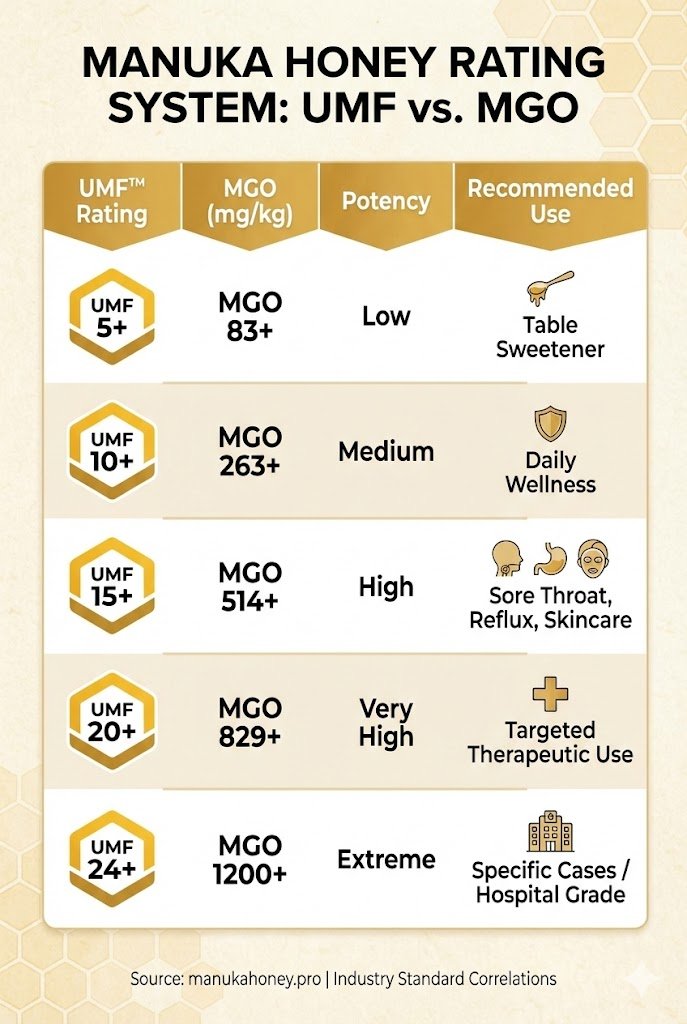
MGO to UMF Conversion Chart (Gold Standard 2026)
Here is the quick cheat sheet: discover exactly which UMF grade corresponds to your MGO level (and vice versa) and find the recommended use for each strength.
| UMF™ Grade | MGO Strength | Best Use For | Cost | Our Top Pick |
|---|---|---|---|---|
| UMF 5+ | 83+ |
☕Daily Wellness
Tea, Toast, Energy
|
$$$$$ | Check UMF 5+ |
| UMF 10+ | 263+ |
🛡️Immune Support
Colds, Prevention
|
$$$$$ | Check UMF 10+ |
| UMF 15+ | 514+ |
✨Therapeutic
Skincare, Acne, Sore Throat
|
$$$$$ | Best Value 🔥 |
| UMF 20+ | 829+ |
🩹Medical Grade
Wound Healing, Digestion
|
$$$$$ | Check UMF 20+ |
| UMF 25+ | 1200+ |
🏥Ultra Premium
Serious Infections, Surgery
|
$$$$$ | Rare Find 💎 |

MGO measures Strength (Potency)
Think of MGO (Methylglyoxal) like the horsepower of a car engine. It tells you exactly how much “power” is under the hood.
What it measures: The concentration of methylglyoxal in mg/kg.
What it tells you: An MGO 500+ jar contains at least 500mg of antibacterial methylglyoxal per kilogram.
The bottom line: It is a precise, scientific measure of potency. The higher the number, the stronger the antibacterial activity.

UMF™ measures Quality (The Full Package)
Think of UMF™ (Unique Manuka Factor) like a Certified Pre-Owned stamp on that car. It confirms the horsepower, but it also checks if the parts are original, if the engine is durable, and if the car is safe to drive.
What it measures: It tests for four key markers:
Potency (MGO level)
Authenticity (Leptosperin – proves it’s from the Manuka flower)
Shelf Life (DHA – ensures the honey stays strong over time)
Freshness (HMF – proves the honey hasn’t been overheated)
The bottom line: UMF™ is a comprehensive quality mark. It guarantees potency plus purity and authenticity.
MGO vs UMF: Which One Should You Choose?
-
Go with MGO (like Manuka Health) if you want a clear, direct measure of strength and often a better price. You know exactly what potency you are paying for.
-
Go with UMF™ (like Comvita) if you want the “Gold Standard” assurance that the honey is 100% pure, raw, and authentic, and you don’t mind paying a slight premium for that guarantee.
Both systems are trustworthy. The only thing you should avoid is honey with no rating at all, or generic terms like “Active 20+” or “Bio-Active,” which are often unregulated marketing fluff.
Expert Conclusion
The “MGO vs UMF” debate isn’t about which is better, but about what they guarantee. While MGO tells you the strength, UMF tells you the strength and the purity.
The Science of Maturation: Why the MGO vs UMF Balance Shifts Over Time
One of the most fascinating aspects of the MGO vs UMF debate lies in how Manuka honey ages. Unlike regular honey, Manuka is a ‘living’ product that actually increases in potency after it is harvested. This is due to a chemical precursor called DHA (Dihydroxyacetone), which is found in the nectar of the Manuka flower. Once the bees turn the nectar into honey, the DHA slowly converts into MGO (Methylglyoxal).
When comparing MGO vs UMF, it is crucial to understand that a simple MGO test only gives you a snapshot of the antibacterial strength at the exact moment of testing. On the other hand, the UMF™ certification is more robust because it also measures DHA levels. This tells the producer (and the consumer) if the honey has the potential to maintain or increase its potency during its shelf life.
If you buy a jar that only lists an MGO rating without UMF oversight, you run the risk of purchasing honey where the MGO levels might decline if the DHA was already exhausted. Therefore, in the MGO vs UMF comparison, UMF acts as a guarantee of ‘future-proof’ quality, ensuring that the MGO vs UMF ratio remains stable and that the bioactivity you paid for is still present when you open the jar months later.
MGO VS UMF TIPS
How to Spot Fake Ratings: Explain that some brands use confusing terms like “Active 20+” or “Bio-Active.” Clarify that these are NOT the same as the MGO vs UMF standards. This helps increase the density of the keyword naturally.
The DNA Test: Mention that New Zealand government regulations (MPI) now require a DNA test for all honey exported as “Manuka.” Explain how this official testing intersects with the MGO vs UMF ratings to provide a dual layer of protection for the buyer.