
Long before it was a global health phenomenon found on the shelves of luxury boutiques in London or New York, Manuka honey was a well-kept secret of New Zealand’s rugged landscape. For centuries, the Leptospermum scoparium (the Manuka bush) was simply a resilient wild shrub. Today, it produces what many call “Liquid Gold.” But the journey from a wild nectar to a certified medical-grade superfood is a tale of indigenous wisdom, accidental discovery, and scientific triumph.

The indigenous Māori people of Aotearoa (New Zealand) were the first to recognize the extraordinary properties of the Manuka plant, though not originally for its honey. Interestingly, honeybees (Apis mellifera) were not native to New Zealand; they were introduced by European settlers in the 1830s.
Before bees arrived, the Māori used the leaves, bark, and gum of the Manuka tree for medicinal purposes. They called it “the healing tree.” Infusions made from the leaves were used to reduce fevers and treat digestive issues, while the bark was applied topically to heal wounds and burns. When European bees finally began foraging on the white and pink Manuka blossoms, the resulting honey inherited these ancient medicinal properties, though it would take over a century for the world to realize it.
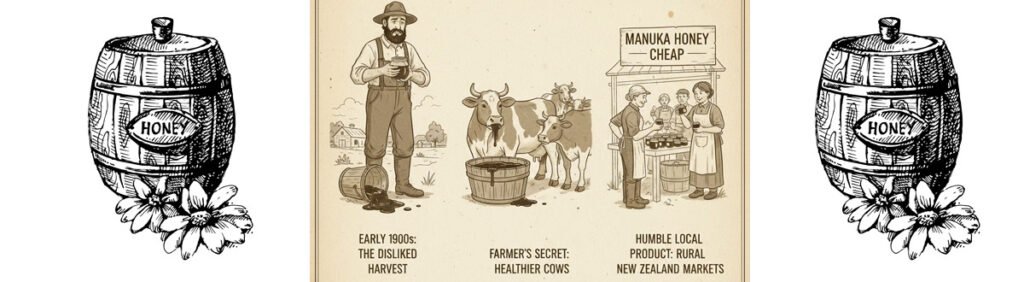
In the early 1900s, Manuka honey was actually disliked by colonial farmers. Because of its strong, earthy taste and thixotropic texture (it’s thicker and more gel-like than clover honey), it was considered a low-quality byproduct.
Farmers used to give it away to dairy farmers to feed their cows or simply threw it away. Legend has it that the “discovery” of Manuka’s benefits began when farmers noticed that cows eating Manuka honey were significantly healthier and more resistant to diseases than those that didn’t. However, for decades, it remained a humble local product, sold cheaply in rural New Zealand markets.
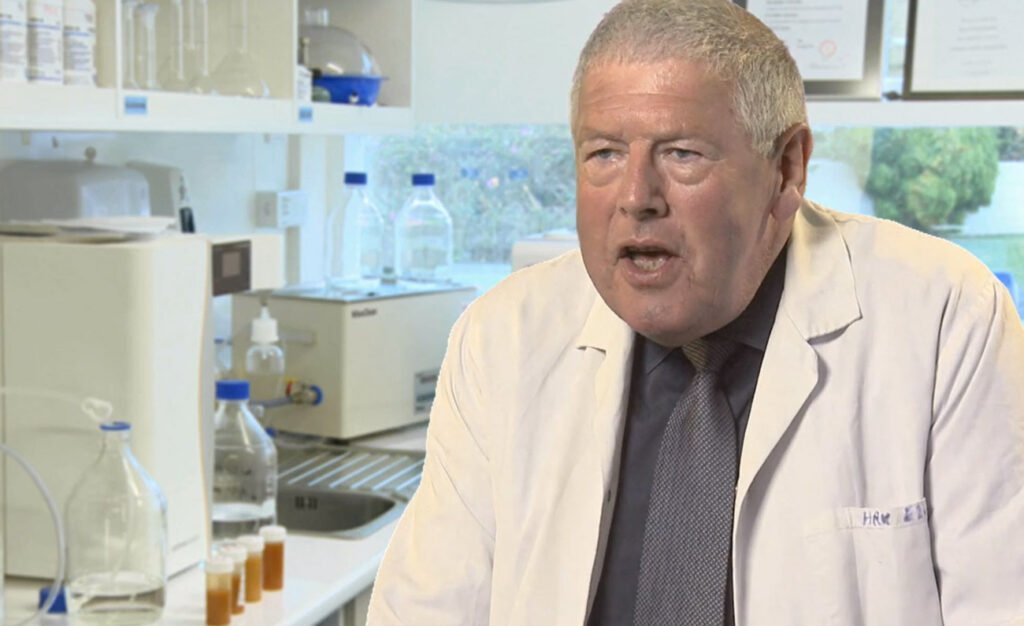
The modern history of Manuka honey changed forever in 1981. Dr. Peter Molan, a professor at the University of Waikato, decided to investigate the antibacterial properties of various New Zealand honeys.
While most honeys have some antibacterial effect due to hydrogen peroxide, Molan discovered that Manuka honey was different. Even when the hydrogen peroxide was removed, the honey continued to kill bacteria. He famously called this the “Unique Manuka Factor” (UMF). This was the “Eureka” moment that triggered a global gold rush. Scientists eventually identified Methylglyoxal (MGO) as the specific compound responsible for this “non-peroxide” activity.
As demand skyrocketed in the 1990s and 2000s, the market became flooded with “fake” Manuka. This led to the creation of formal regulatory bodies to protect consumers and the reputation of New Zealand’s export.
In 1998, the UMF Honey Association was established to create a rigorous grading system that tested for authenticity. Later, the MGO rating system was popularized, providing a direct measurement of the honey’s potency. Today, the New Zealand government (MPI) enforces strict DNA testing and chemical profiling for every batch of honey exported as “Monofloral Manuka.”
To understand how these modern standards affect the honey you buy today, you can explore our MGO vs UMF definitive guide.
Today, Manuka honey is more than a food; it is a bridge between ancient Māori tradition and modern clinical medicine. Whether used in high-tech wound dressings in hospitals or as a luxury face mask for a “glow,” the history of Manuka honey is a testament to the power of nature when validated by science.
As we look toward the future, the focus remains on sustainability and protecting the bees that make this miracle possible.

Manuka Honey Pro is a dedicated platform for health enthusiasts seeking the truth about the world’s most powerful superfood. Our mission is to simplify the science behind Manuka honey, guiding you through MGO ratings and UMF certifications with expert transparency.
Affiliate Disclosure: ManukaHoney.pro is a participant in the Amazon Services LLC Associates Program, an affiliate advertising program designed to provide a means for sites to earn advertising fees by advertising and linking to Amazon.com. As an Amazon Associate, we earn from qualifying purchases. This comes at no extra cost to you and helps support our research.